
The best another word for patiently is calmly. For other kinds of patience, use tolerantly to put up with people, diligently for steady work, stoically to hide your feelings, or steadfastly to never give up.
A few years ago, I watched an editor named Marianne read a manuscript that three publishers had rejected. The author had written the word “patiently” forty one times in a single chapter. She waited patiently, listened patiently, explained patiently, endured patiently. Marianne did not cross the word out in anger. She sat with a cup of tea and read each sentence aloud. Every time, she asked one question: what kind of patience is this?
Some of it was calm patience. Other parts were stubborn patience. A few were the tired, gritted teeth kind. By the end of the afternoon, the chapter had thirty different words. Each one did work that a single overused word had done badly. The manuscript was accepted later, and the editor told the author that the story had not changed. Only the precision had.
That afternoon taught me something I still believe. Patience is not one feeling, so “patiently” should not be one word. Are you searching for another word for patiently? Then you are really asking how to describe a specific way of waiting, enduring, or staying calm. This guide will help you find the right word for each situation. You will get clear meanings, examples, and the small differences that separate a good writer from a forgettable one.
What Does Patiently Mean?
“Patiently” is an adverb. It describes an action done with calm endurance, without complaint, anger, or hurry. When someone waits patiently, they accept delay without becoming upset. When someone teaches patiently, they stay gentle even when the student struggles.
The word comes from the Latin root “pati,” which means to suffer or to endure. That origin is useful, because it reminds us that patience often carries a hint of difficulty. A person who waits patiently is not always waiting happily. They may be choosing self control over frustration.
This is exactly why synonyms matter. The word “patiently” covers a wide field, and your sentence usually lives in only one corner of it.
Quick List: Another Word for Patiently
Before we go deeper, here are the most useful alternatives you can reach for right away:
- Calmly
- Quietly
- Tolerantly
- Composedly
- Serenely
- Stoically
- Persistently
- Diligently
- Steadily
- Perseveringly
- Uncomplainingly
- Forbearingly
- Indulgently
- Gently
- Graciously
- Unhurriedly
- Leisurely
- Placidly
- Evenly
- Resignedly
- Philosophically
- Tirelessly
- Faithfully
- With composure
- With restraint
- Impassively
- Imperturbably
- Unflappably
- Equably
- Unemotionally
- Meekly
- Sedately
- Bravely
- Steadfastly
- Unwaveringly
- Resolutely
- Tenaciously
- Doggedly
- Assiduously
- Indefatigably
Not every word on this list fits every sentence. So let us sort them by the kind of patience they express. That is where real writing skill shows up.
Synonyms for Patiently Based on the Situation
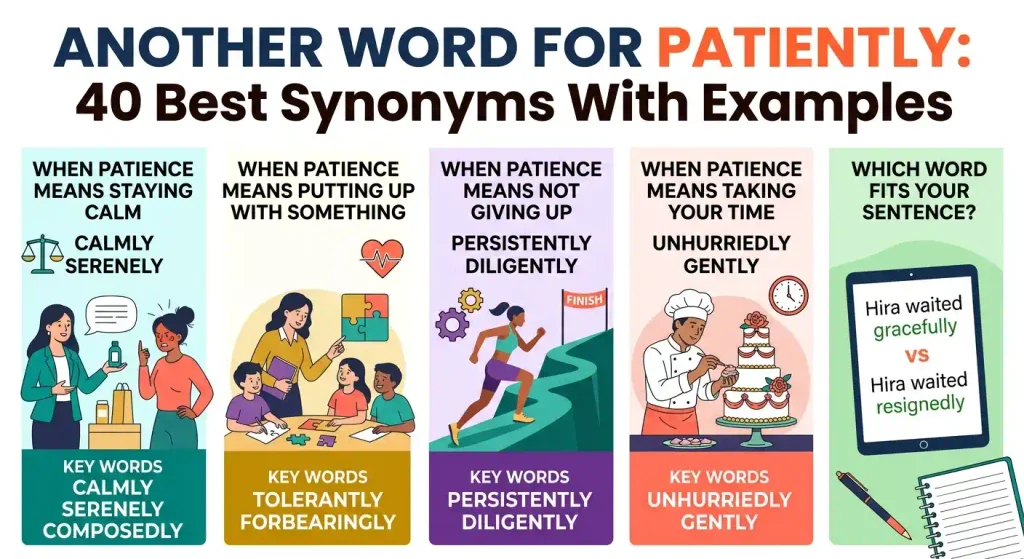
When Patience Means Staying Calm
This group is for moments when someone keeps their emotions steady while things are difficult, slow, or annoying.
Calmly is the most natural and flexible choice. It focuses on the absence of agitation. For example, “She calmly explained the delay to the angry customers.”
Serenely adds a layer of peace, almost beauty. It suggests the person is not just controlled but truly untroubled. For instance, “The old fisherman sat serenely on the dock while the storm clouds gathered.”
Placidly carries a similar meaning, though it can sometimes suggest a dull or cow like stillness. For example, “The cattle chewed placidly as the train rolled past.”
Composedly points to self command. The person might feel pressure but keeps their poise. For instance, “He answered the reporter’s hostile question composedly.”
Evenly describes a steady tone or temper. For example, “She spoke evenly, even after the third interruption.”
When Patience Means Putting Up With Something
Sometimes patience is not about calm. It is about tolerance, about letting someone or something test you without snapping back.
Tolerantly suggests acceptance of other people’s flaws or mistakes. For example, “The teacher listened tolerantly to the same excuse she had heard a hundred times.”
Indulgently has a warmer, slightly affectionate flavor, as when an adult watches a child. For instance, “Grandfather smiled indulgently as the toddler rearranged his shoes.”
Forbearingly is a more formal word, describing restraint when you have every right to react. For example, “The judge forbearingly allowed the witness to repeat his answer.”
Uncomplainingly focuses on the silence of the person enduring. For instance, “The nurses worked uncomplainingly through the double shift.”
Resignedly carries the sense of giving in to what cannot be changed. Be careful here, because it can sound sad or defeated. For example, “He sighed and waited resignedly for the results.”
Stoically describes endurance without showing emotion, inspired by the ancient Stoic philosophers. For instance, “The soldiers stoically accepted their orders.”
When Patience Means Staying Unshaken
These words describe patience that nothing seems able to disturb.
Impassively describes patience with a blank face that gives nothing away. For example, “The guard stood impassively while the crowd shouted.”
Imperturbably goes one step further and means that nothing can disturb the person. For instance, “The old pilot imperturbably guided the plane through the storm.”
Unflappably is the modern, slightly informal choice for people who stay cool while everyone else panics. For example, “The event manager unflappably rearranged the whole schedule when the rain began.”
Equably points to an even, balanced temper over time, not just in one moment. For instance, “She answered the complaint equably, as she always did.”
Unemotionally suits cold, factual patience, often in medical, legal, or technical writing. For example, “The doctor unemotionally explained the long road to recovery.”
Meekly describes patience that comes from humility or fear of conflict, so use it with care. For instance, “The boy meekly waited outside the principal’s office.”
Sedately adds a slow, dignified calm. For example, “The elderly couple sedately waited for their turn at the counter.”
Bravely adds courage to the waiting, which makes it ideal for hard situations. For instance, “The family bravely waited for news from the hospital.”
When Patience Means Not Giving Up
This is the active side of patience. The person is not just waiting. They are working, trying, and pushing forward over time.
Persistently highlights repeated effort despite obstacles. For example, “She persistently applied for the scholarship until she finally won it.”
Perseveringly is a more elegant cousin of persistently. It carries the sense of noble determination. For instance, “The scientists perseveringly refined their experiment for eleven years.”
Diligently points to careful, steady work. For example, “He diligently copied the old records by hand.”
Tirelessly suggests energy that never seems to run out. For instance, “The volunteers tirelessly searched the hillside.”
Steadily gives a rhythm of constant, reliable progress. For example, “The students steadily improved over the semester.”
Faithfully adds loyalty to the picture. For instance, “She faithfully tended her mother’s garden every morning.”
When Patience Means Strong Determination
These words add force and loyalty to the effort, so they suit long and hard struggles.
Steadfastly shows firm loyalty to a purpose, even when it is hard. For example, “The villagers steadfastly refused to leave their land.”
Unwaveringly means without doubt or hesitation. For instance, “He unwaveringly supported his brother through the long trial.”
Resolutely adds a strong decision to the effort. For example, “She resolutely rebuilt the shop after the flood.”
Tenaciously describes a grip that will not let go. For instance, “The lawyer tenaciously pursued the case for years.”
Doggedly suggests stubborn, plodding effort. It can sound slightly negative, so choose it when determination matters more than grace. For example, “The reporter doggedly followed the story for months.”
Assiduously points to careful, constant attention to detail. For instance, “The librarian assiduously repaired every damaged book.”
Indefatigably is a rare, powerful word for someone who never seems to tire. For example, “The nurse indefatigably cared for her patients all winter.”
When Patience Means Taking Your Time
Some patience is about pace. The person is not rushed and does not rush others either.
Unhurriedly is the best word for a relaxed pace. For instance, “The chef unhurriedly folded the dough, knowing the bread could not be forced.”
Leisurely works as an adverb in some contexts, though it often appears as an adjective. For example, “They strolled leisurely through the old bazaar.”
Gently suggests softness in manner, especially when dealing with someone fragile or nervous. For instance, “The vet gently coaxed the frightened puppy out of the box.”
When Patience Is About Wisdom and Perspective
Philosophically describes accepting a hardship with thoughtful perspective. For example, “He took the loss of the contract philosophically and started preparing his next pitch.”
Graciously adds courtesy and kindness to the patience. For instance, “She graciously waited while the shy applicant gathered his thoughts.”
With composure and with restraint are phrases that work well when a single word feels too thin.
Quick Comparison: Which Word Fits Which Situation
When you are in a hurry, use this table to pick the right word in seconds.
| Word | Best for | Tone | Example |
| Calmly | Staying peaceful under pressure | Neutral | She calmly answered every question. |
| Tolerantly | Putting up with other people | Warm | He listened tolerantly to the long story. |
| Diligently | Careful, steady work | Formal | The team worked diligently all week. |
| Persistently | Repeated effort after setbacks | Strong | She persistently asked for a refund. |
| Stoically | Hiding pain or worry | Serious | He stoically accepted the news. |
| Serenely | Deep, visible peace | Poetic | The monk sat serenely by the lake. |
| Steadfastly | Loyal, firm determination | Formal | They steadfastly protected the town. |
| Indulgently | Affectionate patience with a child | Gentle | She smiled indulgently at the noise. |
| Unhurriedly | Taking your time | Relaxed | He unhurriedly packed his bag. |
| Resignedly | Accepting what cannot change | Sad | She waited resignedly for the train. |
Another Word for Patiently in Formal Writing
Formal writing demands precision. In academic papers, business reports, and professional letters, you want words that sound measured and respectful.
The strongest choices include diligently, perseveringly, composedly, forbearingly, and with forbearance. Consider this sentence from a workplace report: “The committee reviewed each proposal diligently before issuing its recommendation.” The word diligently tells the reader that the review was careful and sustained. The word “patiently” alone would not capture that.
For a formal letter, you might write: “We thank you for waiting with understanding while our team resolved the issue.” Notice that the sentence avoids the adverb altogether. Sometimes the best synonym for patiently is a rephrased sentence.
Another Word for Patiently in Everyday Conversation
In casual talk, simpler words win. People rarely say “forbearingly” over dinner. Instead, they use calmly, quietly, without complaining, without fuss, or even phrases like “took their time” and “hung in there.”
A friend might say, “He waited quietly while the kids finished their game.” Another might say, “She stayed calm the whole time.” These feel natural, human, and warm.
Matching your word to your audience is a quiet skill that expert writers practice every day. A gentle word in the wrong setting can feel like a costume.
Another Word for Patiently at Work, at Home, and Online
A support manager I know, Daniel, once played me a recording of a very long, very angry phone call. The agent on the line never raised her voice. When I asked what made her so good, Daniel said, “She is not patient. She is just precise about what she is doing.” He meant that she softened her tone, slowed her pace, and chose her words with care. Patience was the result, not the trick.
That idea helps in real life, because the best word changes with the place.
At Work
In reviews, reports, and team messages, choose words that show skill and effort. “She calmly handled the escalation” sounds professional. “The team worked diligently through the migration” shows steady effort. “He answered the client’s concerns courteously and in full” shows respect.
At Home With Children
Warm, soft words fit family life. “He gently repeated the lesson” feels loving. “She listened indulgently to the same story for the tenth time” feels affectionate. “They unhurriedly tied each small shoe” shows time given freely.
In Emails and Messages
The phrase “thank you for waiting patiently” can sound stiff or even a little bossy. These alternatives feel warmer:
- Thank you for your understanding
- Thanks for bearing with us
- We appreciate your patience
- Thank you for staying with us
- We are grateful for your time
- Thanks for giving us a moment to sort this out
A Short Story to Show the Difference
Let me show you how much a single word can change a scene. Imagine a young woman named Hira sitting in a government office, waiting for a stamped document.
If we write, “Hira waited patiently,” the reader learns almost nothing. We know she is waiting. We do not know how she feels.
Now try these versions.
“Hira waited stoically, her hands folded over her bag, refusing to let the clerk see her worry.” Now we feel her pride and hidden fear.
“Hira waited serenely, watching the ceiling fan turn, as if the delay were a small gift of rest.” Now she seems wise and peaceful.
“Hira waited resignedly, because she had learned that complaining only made the line longer.” Now we sense a history of frustration.
“Hira waited persistently, returning to the counter every hour with a polite smile and the same question.” Now she is a quiet fighter.
One scene, four different women, and every change came from choosing a better word than “patiently.” This is the true power of synonyms. They are not decoration. They are character.
Example Sentences Using Synonyms of Patiently
Seeing words inside sentences helps them stick in memory. Here are examples across different contexts.
Calmly: The pilot calmly informed the passengers about the turbulence.
Tolerantly: The shopkeeper tolerantly answered the tourist’s fifth question about the same carpet.
Diligently: The apprentice diligently sanded the table until it felt like silk.
Uncomplainingly: The porters carried the heavy luggage up the mountain uncomplainingly.
Perseveringly: The explorers perseveringly pushed through the thick jungle for weeks.
Indulgently: The coach watched indulgently as the children celebrated a goal that did not count.
Gently: The counselor gently waited for the boy to find his words.
Philosophically: The farmer took the failed harvest philosophically and planted again.
Unhurriedly: The potter unhurriedly shaped the clay, never looking at the clock.
Graciously: The host graciously waited while the late guests found their seats.
Read these aloud. Each word changes the music of the sentence. That is a clue to when it belongs.
What Is the Opposite of Patiently?
Understanding antonyms helps you feel the edges of the word. The opposite of patiently includes:
- Impatiently
- Hastily
- Restlessly
- Irritably
- Anxiously
- Rashly
- Hurriedly
- Impulsively
- Testily
- Eagerly
Notice that “eagerly” is a softer opposite. A person can wait eagerly without being angry, yet they are not truly patient in that moment. Contrasts like this are useful when you write character studies, because patience often shines brightest beside its opposite.
Common Mistakes When Replacing Patiently
Even careful writers stumble when they hunt for synonyms. Here are the traps I see most often.
Choosing a Word With the Wrong Emotion
“Resignedly” is not a safe swap for “patiently.” Resignation suggests defeat, while patience suggests strength. Using the wrong one can change the whole meaning of your sentence.
Picking a Word That Is Too Fancy
Writers sometimes grab “forbearingly” or “longanimously” because they sound impressive. If your reader has to open a dictionary, you have lost them. Clarity beats decoration every time.
Forgetting That Some Synonyms Describe Action, Not Attitude
“Persistently” and “diligently” focus on effort, not on calm. If the point of your sentence is emotional composure, these words may shift the focus away from what you meant.
Overusing Adverbs Altogether
Strong writing often replaces the adverb with a stronger verb or a vivid detail. Instead of “She waited patiently,” try “She folded her hands and watched the door without tapping her foot.” The reader sees the patience instead of being told about it.
How to Choose the Right Synonym Every Time
Here is the simple method I teach new writers. Ask three questions before you pick a word.
First, ask what the person is feeling inside. Are they peaceful, annoyed, defeated, or determined? Your answer points to a family of words.
Second, ask what the person is doing outwardly. Are they waiting, working, listening, or enduring? Action words like persistently and diligently fit working. Quiet words like calmly and serenely fit waiting.
Third, ask who is reading. A teenager, a judge, and a customer all deserve different vocabulary.
Run those three checks and the right word usually announces itself.
Phrases That Work as Another Word for Patiently
Single words are not your only option. Phrases can carry the same meaning with extra flavor.
- With great composure
- Without losing their temper
- With quiet endurance
- Without complaint
- Keeping their cool
- With steady resolve
- Taking it in stride
- With an even temper
- Bearing with it
- With good grace
- Without a word of protest
- With calm determination
Phrases like “taking it in stride” suit conversational writing, while “with quiet endurance” suits literary or reflective pieces. Keep a small list like this near your desk, and your writing will begin to sound richer without effort.
Why Variety in Word Choice Matters
Search engines, readers, and editors all reward writing that feels alive. Repeating the same word again and again makes a paragraph feel flat, almost tired. Varying your vocabulary keeps the reader engaged and shows command of the subject.
But variety is not about showing off. It is about accuracy. Every time you replace “patiently” with a word that truly fits, you give the reader a clearer picture. Marianne, the editor from the beginning of this article, understood this. She never believed in swapping words for the sake of difference. She believed in finding the exact word hiding behind the lazy one.
Frequently Asked Questions
What is the best another word for patiently?
There is no single best word, because the answer depends on the situation. For calm waiting, use “calmly” or “serenely.” For effort over time, use “persistently” or “diligently.” And for tolerance of others, use “tolerantly” or “indulgently.”
Is calmly a good synonym for patiently?
Yes, in many cases. “Calmly” is probably the most flexible replacement. However, it describes emotional steadiness only, while “patiently” can also include the idea of enduring a delay. If waiting is the main point, add context so the meaning stays clear.
What is a formal word for patiently?
Good formal options include “diligently,” “perseveringly,” “composedly,” and “forbearingly.” These fit reports, essays, and professional correspondence.
What is a simple word for patiently?
“Calmly,” “quietly,” “gently,” and “steadily” are simple and easy for any reader to understand. Phrases such as “without complaining” also work well in plain language.
Can persistently replace patiently?
Only sometimes. “Persistently” stresses repeated effort and refusal to quit, while “patiently” stresses calm endurance. They overlap in stories about long struggles, but they are not identical.
What is the difference between patiently and tolerantly?
“Patiently” describes calm waiting or endurance in general. “Tolerantly” specifically describes accepting other people’s behavior or differences without anger. You wait patiently for a bus, but you listen tolerantly to someone whose opinion you disagree with.
What is another word for waiting patiently?
Good options include “waiting calmly,” “waiting quietly,” “waiting serenely,” and “waiting without complaint.” For a stronger feeling, try “waiting stoically” or “waiting steadfastly.”
What is a strong word for patiently?
For a powerful tone, use “resolutely,” “tenaciously,” “steadfastly,” “unwaveringly,” or “indefatigably.” These suggest patience with real force behind it.
What is a negative word for patiently?
“Resignedly,” “meekly,” and “doggedly” can carry a slightly negative or weary feeling. They are useful when you want to show defeat, fear, or stubbornness instead of calm strength.
Final Thoughts
Finding another word for patiently is really an exercise in paying attention. Every time you reach for that familiar adverb, pause and ask what kind of patience you are describing. Is it the peaceful kind, the stubborn kind, the weary kind, or the kind that quietly refuses to give up?
When you answer that honestly, the right word almost always appears. Calmly, serenely, diligently, stoically, indulgently, perseveringly: each one carries its own small story. Writers who remember this create sentences that stay in a reader’s mind long after the page is closed.
Keep this list close, practice with real sentences, and let your vocabulary grow one precise word at a time. Like patience itself, good writing rewards those who take it seriously and give it time.
Read More:Another Word for Shortcoming: 30 Best Synonyms

Hi, I’m Ayesha. I believe the right word can transform a sentence, strengthen an idea, and make communication more impactful. That’s why I created this site, to help writers, students, professionals, and English learners find accurate synonyms, antonyms, and better word choices quickly and effortlessly.
Pingback: Another Word for Shortcoming: 30 Best Synonyms - publishscale.com