
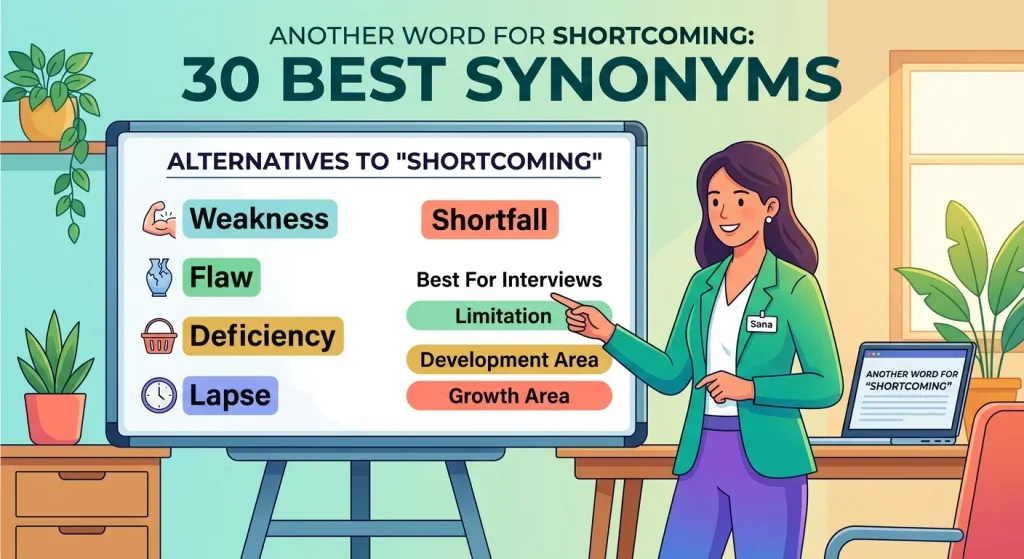
The best another word for shortcoming is weakness. For other meanings, use flaw for a visible fault, drawback for a downside, deficiency for something missing, or lapse for a small mistake.
Years ago, I sat in on a job interview as a writing coach. The candidate was a young designer named Sana. She was bright, calm, and well prepared. Then the manager asked a classic question: “What is your biggest shortcoming?”
Sana paused for a moment. Finally, she said, “I care too much.” The manager smiled politely and wrote nothing down.
Later, over tea, he told me something I never forgot. “Every candidate gives me a disguised strength,” he said. “I do not want a trick. I want honesty, and I want the right word.”
That afternoon taught me a simple lesson. A shortcoming is not one thing. It can be a weakness, a mistake, a missing skill, or a weak point in a system. So the word you choose changes the message.
Are you searching for another word for shortcoming? This guide will help you choose well. You will learn what each synonym means. You will also see when to use it, with clear examples.
What Does Shortcoming Mean?
“Shortcoming” is a noun. It describes a fault or weakness in a person, plan, or thing. It points to a place where something fails to reach a standard.
The word comes from the old phrase “come short.” That phrase means to fall below what is expected. So the idea of a gap sits inside the word itself.
However, the word does not carry heavy blame. A flaw can sound harsh, and a failure can sound final. A shortcoming sounds milder. It suggests something that can still be improved.
Because the meaning is so wide, synonyms matter. One word may describe a personal habit. Another may describe a missing resource. A third may describe a loophole in a rule.
Quick List: Another Word for Shortcoming
Here are the most useful alternatives you can use right away:
- Weakness
- Flaw
- Defect
- Imperfection
- Foible
- Frailty
- Blemish
- Weak point
- Vulnerability
- Deficiency
- Shortfall
- Shortage
- Deficit
- Lack
- Inadequacy
- Limitation
- Gap
- Lapse
- Oversight
- Error
- Fault
- Failing
- Negligence
- Ineptitude
- Incompetence
- Drawback
- Disadvantage
- Downside
- Snag
- Loophole
Not every word fits every sentence. So let us sort them by meaning. That is where good writers make smart choices.
Synonyms for Shortcoming Based on Meaning
When a Shortcoming Means a Weakness
This group describes a weak spot in a person or thing. It points to something that makes them less strong.
Weakness is the most natural choice. It works for people, plans, and products. For example, “Impatience is his main weakness.”
Flaw points to a visible fault. Often, it spoils something that would otherwise be perfect. For instance, “The diamond had one small flaw.”
Defect sounds technical. It fits products and machines. For example, “The factory found a defect in the brakes.”
Imperfection is softer than flaw. It suggests something small and human. For instance, “She loved the imperfections in the handmade bowl.”
Foible describes a harmless quirk. It often sounds gentle and even affectionate. For example, “His only foible was losing his keys.”
Frailty points to a human weakness, often moral or physical. It sounds serious and quiet. For instance, “The novel explores the frailties of ordinary people.”
Blemish means a mark that spoils a good record. For example, “One late payment was the only blemish on his history.”
Weak point is plain and clear. It fits plans, arguments, and defenses. For instance, “The weak point of the plan was its budget.”
Vulnerability suggests a weakness that others could exploit. For example, “The audit revealed a vulnerability in the system.”
When a Shortcoming Means Something Missing
Here, the problem is a lack, not a fault. Something simply is not enough.
Deficiency means too little of something needed. For example, “The doctor found a vitamin deficiency.”
Shortfall describes a gap between what you have and what you need. For instance, “The charity faced a shortfall of funds.”
Shortage is a simple word for not enough supply. For example, “The town had a shortage of teachers.”
Deficit often appears in money and measurement. For instance, “The company reported a deficit after the first quarter.”
Lack is short and direct. For example, “Lack of sleep was his biggest problem.”
Inadequacy suggests that something is not good enough. For instance, “She felt the inadequacy of her old laptop.”
Limitation names a boundary. It does not always carry blame. For example, “The software has one limitation, which is storage.”
Gap suggests something missing between two points. For instance, “The report shows a gap in our training.”
When a Shortcoming Means a Mistake
Sometimes a shortcoming is an error that someone made. These words suit small, honest slips.
Lapse describes a brief failure of attention. For example, “A lapse in memory caused the delay.”
Oversight means something missed by accident. For instance, “Leaving out his name was an oversight.”
Error is a direct word for something wrong. For example, “The report contained one error in the total.”
Fault points to responsibility. It answers who or what caused the problem. For instance, “The fault lay with the old wiring.”
Failing is a gentle word for a personal weakness. For example, “Being late was his only failing.”
When a Shortcoming Means Poor Skill or Care
These words are stronger. They suggest a lack of care or ability, so use them carefully.
Negligence means failing to take proper care. It often appears in legal writing. For example, “The court found the owner guilty of negligence.”
Ineptitude describes a clumsy lack of skill. For instance, “His ineptitude with numbers cost the firm dearly.”
Incompetence means being unable to do a job well. For example, “The manager was dismissed for incompetence.”
Because these words can hurt, avoid them in feedback unless the facts are clear.
When a Shortcoming Means a Downside
Some shortcomings are not about people at all. They are the less pleasant side of a choice.
Drawback is the perfect word for a downside. For example, “The main drawback of the phone is its battery.”
Disadvantage compares one option against another. For instance, “Distance is a disadvantage of living in the village.”
Downside is casual and friendly. For example, “The downside is the long wait.”
Snag suggests a small obstacle. For instance, “We hit a snag when the printer failed.”
When a Shortcoming Is a Loophole
In law and rules, a shortcoming can be a gap that people use to their advantage.
Loophole means a gap that lets someone avoid a rule. For example, “The tax loophole was finally closed.”
Technicality is a small detail in a rule that changes the outcome. For instance, “The case ended on a technicality.”
Quick Comparison: Which Word Fits Which Situation
When you are in a hurry, use this table to pick the right word in seconds.
| Word | Best for | Tone | Example |
| Weakness | A general weak spot | Neutral | Impatience is his weakness. |
| Flaw | A visible fault | Serious | The vase had a tiny flaw. |
| Foible | A harmless quirk | Gentle | Her foible is arriving early. |
| Deficiency | Something missing | Formal | The soil has a nutrient deficiency. |
| Drawback | A downside | Neutral | The drawback is the price. |
| Lapse | A brief mistake | Mild | A lapse in focus caused the error. |
| Negligence | Failure to take care | Strong | The report cited negligence. |
| Loophole | A gap in the rules | Formal | The law had a loophole. |
Another Word for Shortcoming in Job Interviews and Resumes
Let me return to Sana. Weeks later, she faced another interview. This time she prepared differently.
She did not use the word shortcoming at all. Instead, she said, “My growth area is public speaking. I have joined a weekly club to improve it.” The manager nodded and took notes.
Why did it work? She named a real limit. She also showed action. That balance builds trust.
Better Phrases for Interviews
If the question feels uncomfortable, try these softer and smarter options:
- Area for improvement
- Growth area
- Development area
- Skill gap
- A challenge I am working on
- A habit I am improving
Each phrase looks forward. As a result, the listener hears progress, not excuses.
What to Avoid
Avoid fake weaknesses like “I work too hard.” Hiring managers hear them every week. Also avoid harsh words about yourself, such as ineptitude or incompetence. They sound hopeless, even when you do not mean it.
Another Word for Shortcoming in Formal Writing
Reports, essays, and legal papers need careful words. In these settings, choose terms that sound measured and fair.
Good formal choices include deficiency, limitation, inadequacy, lapse, and negligence. For example, “The audit identified several deficiencies in record keeping.” Likewise, “The report notes a lapse in procedure.”
Limitation is a favorite in research papers. For instance, “The study has one limitation: a small sample size.” The word is honest, but it does not blame anyone.
Another Word for Shortcoming in Everyday Conversation
In daily talk, simple words win. Nobody says “ineptitude” at the dinner table. Instead, people use easy phrases that feel warm and natural.
Try weak spot, downside, flaw, or thing to work on. You can also say “not my strong suit,” “room for improvement,” or “blind spot.”
A friend once told me, “Cooking is my weak spot.” She laughed, and so did I. The phrase was honest, light, and easy to say. That is exactly why casual words work.
Example Sentences Using Synonyms of Shortcoming
Seeing words in sentences helps them stick. Here are ten examples from different settings.
Weakness: Her only weakness was a love of sweets.
Flaw: The engineer found a flaw in the bridge design.
Drawback: The biggest drawback of the plan is the cost.
Deficiency: The report showed a deficiency in staff training.
Lapse: A brief lapse in judgment ruined the evening.
Oversight: Forgetting the invitation was an honest oversight.
Limitation: The camera has one clear limitation in low light.
Negligence: The company paid a fine for negligence.
Loophole: The lawyer found a loophole in the contract.
Foible: Everyone smiled at the professor’s foible of wearing mismatched socks.
Read these aloud. Each word changes the feel of the sentence. That is a clue to when it belongs.
What Is the Opposite of Shortcoming?
Knowing the opposite helps you see the edges of a word. The opposite of shortcoming includes:
- Strength
- Strong point
- Merit
- Virtue
- Advantage
- Asset
- Forte
- Plus
Notice that these words describe what works well. For example, “Patience is her greatest strength.” In the same way, “Speed is the main advantage of this tool.” Shortcomings and strengths often sit side by side, so a fair review mentions both.
Common Mistakes When Replacing Shortcoming
Even careful writers stumble here. Let us look at the most common traps.
Choosing a Word That Is Too Harsh
“Incompetence” and “negligence” are heavy words. They suggest blame, and sometimes they suggest wrongdoing. If you only mean a small gap, choose “limitation” or “weak spot” instead.
Using a Technical Word in Casual Talk
“Deficiency” and “vulnerability” fit reports well. However, they sound stiff in a chat with a friend. Match the word to the room.
Mixing Up Flaw and Fault
These two look alike, but they differ. A flaw is an imperfection in something. A fault points to who or what caused a problem. So you can say “a flaw in the glass” but “the fault lies with the driver.”
Forgetting That Shortcoming Is a Noun
“Shortcoming” is a noun, so its synonyms should also be nouns. For example, you can say “a weakness” or “a drawback.” You cannot say “a weakly.” Check the part of speech before you swap.
How to Choose the Right Synonym Every Time
Here is a simple method I teach new writers. Ask three questions before you decide.
First, ask what kind of problem you mean. Is it a weak trait, a missing resource, a mistake, or a downside? The answer points to a family of words.
Second, ask how serious the problem is. A foible is tiny. A defect is real. Negligence is severe.
Third, ask who is reading. A manager, a friend, and a judge all expect different language.
With these three checks, the right word usually appears quickly.
Frequently Asked Questions
What is the best another word for shortcoming?
There is no single best word, because the answer depends on the situation. Use “weakness” for a general weak spot. Use “drawback” for a downside. And use “deficiency” for something missing.
What is a formal word for shortcoming?
Good formal options include “deficiency,” “limitation,” “inadequacy,” and “lapse.” These suit reports, essays, and professional letters.
What is a positive word for shortcoming?
Try “area for improvement,” “growth area,” or “development area.” These phrases focus on progress, not blame. For that reason, they work well in interviews and reviews.
What is a simple word for shortcoming?
“Weakness,” “flaw,” “downside,” and “weak spot” are simple and clear. Any reader can understand them at once.
What is the difference between shortcoming and weakness?
A weakness is a general lack of strength. A shortcoming is a specific place where something falls short of a standard. In many sentences, the two words can swap. However, “shortcoming” often sounds a little milder and more formal.
Is shortcoming a negative word?
Mildly, yes. It points out a problem, but it sounds gentler than “failure” or “defect.” Because of that, it is popular in reviews and interviews.
Final Thoughts
Finding another word for shortcoming is really about precision. Before you choose, pause and ask what kind of problem you are describing. Is it a weak trait, a gap, a slip, or a downside?
When you answer honestly, the right word appears. Weakness, flaw, deficiency, lapse, drawback, and limitation each tell a different small story. Writers who notice these differences write with more clarity and more kindness.
Sana learned this in her second interview. Her honest words, chosen with care, won the job. Keep this list close, practice with real sentences, and your own writing will improve one precise word at a time.
Read More: Another Word for Patiently: 40 Best Synonyms With Examples

Hi, I’m Ayesha. I believe the right word can transform a sentence, strengthen an idea, and make communication more impactful. That’s why I created this site, to help writers, students, professionals, and English learners find accurate synonyms, antonyms, and better word choices quickly and effortlessly.
Pingback: Another Word for Trachea: Simple Terms You Can Use - publishscale.com